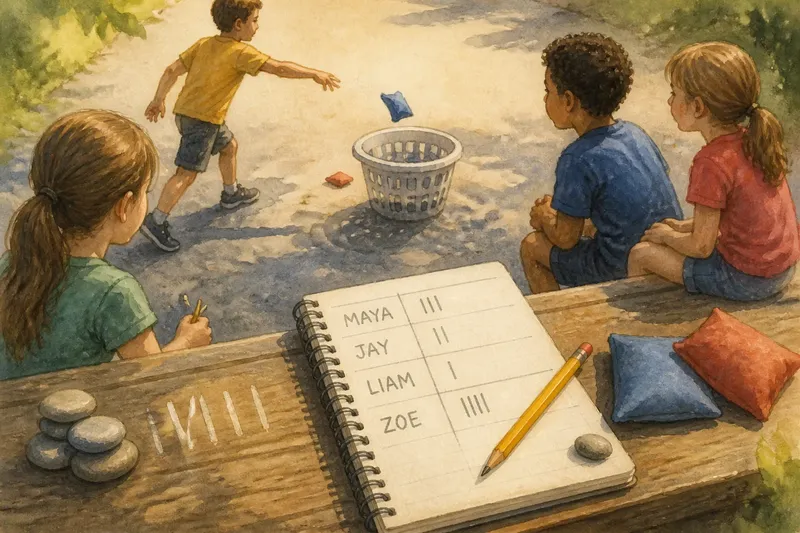
Short Rounds or One Long Game?
Short rounds or one long game? Compare how each format handles rotation, rest, and changing attendance so your group can choose a rhythm that fits its play.

A ball keeps rolling back to the same player, while two others wait beside the sideline. Choosing short rounds or one long game can change how turns are shared, how often play pauses, and whether the group gets the steady rhythm it wants.
Short rounds or one long game
Short rounds divide play at a recognizable endpoint: each person has taken a turn, a target has been reached, or the group has called time. At each boundary, players can adjust teams, switch roles, or take a breather before the next round.
A continuous game has no scheduled reset. It suits players who enjoy carrying momentum from one turn to the next, but the group needs a simple way to handle ordinary changes without turning every pause into a negotiation.
The choice is about rhythm, not which format is more serious. Short rounds make transitions predictable but interrupt play; continuous play preserves flow but leaves transitions less regular.
Round boundaries
A useful endpoint is easy to notice and does not rely on a disputed call. In a throwing game, the group might finish a round after everyone has thrown once. In a tag game, it might end when a player reaches a designated safe zone. Either way, everyone can tell when the next decision belongs.
Round boundaries also make rotation visible. The group can name who throws next, move a player from scoring to playing, or change teams before the ball is active. A short, repeatable order is easier to follow than an informal promise to “switch people around.”
Keep the endpoint connected to the game rather than adding a rule that needs constant explanation. If players regularly disagree about whether a round has ended, choose a clearer signal or simpler condition.
Continuous rhythm
One long game can be a good fit when attendance is steady and players want extended movement. A natural lull, such as the ball going out of play, can offer a moment to change roles or take a brief pause without ending the whole game.
The group should agree on what happens at that moment. For example, a player leaving might name who takes the next turn, while a substitute joins only after the current attempt is over. A shared convention keeps a change from becoming a fresh debate every time.
Continuous play asks players to notice one another. If someone repeatedly waits for a chance to join or rest, the group may need a more predictable pause rather than relying on the next lull to arrive conveniently.
Choosing a format
Think about the group’s preferred pace, the kind of game, and how much attention players want to spend on transitions. Short rounds work well when people value regular opportunities to rotate. Continuous play may suit a group that prefers sustained action and can manage changes during natural breaks.
- Observe whether players are waiting for turns; if the wait feels frustrating, use a round boundary to rotate, or shorten the active sequence if a full round still leaves people waiting.
- Observe whether players want regular rests; if they do, set a clear break between rounds, or keep continuous play with an agreed pause signal if stopping after every round would disrupt the group’s preferred pace.
- Observe whether the group enjoys uninterrupted action; if frequent resets weaken the rhythm, try continuous play, or keep short rounds if players need predictable chances to change roles.
- Observe whether teams need frequent adjustment; if players want changes, make them at each round boundary, or use a natural stoppage in continuous play if the group wants fewer resets.
- Observe whether players can remember the rotation order; if they lose track, simplify it to a visible sequence, or appoint a rotating scorekeeper if the game needs a record of turns.
- Observe whether pauses lead to disputes about the score or next turn; if they do, agree on a clear restart rule, or choose a simpler endpoint if the current one remains hard to judge.
Say a group of friends has one soft ball, four cones, and a throwing game in which each player aims at a cone-marked zone. They want to keep moving, but two players have asked for a chance to switch roles without interrupting a throw. They agree that each person throws once per round, then rotate the thrower and scorekeeper before restarting. The observable result is a regular moment to change roles; the tradeoff is that the ball stops after every player has thrown. If the group later prefers a steadier flow, it can keep the same throwing rules and move role changes to natural pauses instead.
Questions about game rhythm?
When are short rounds better?
Short rounds help when players want regular chances to rotate, rest, or reconsider teams. Choose an endpoint everyone can recognize without stopping to interpret a close call.
When does continuous play work?
Continuous play fits a group that values sustained action and can handle changes at natural stoppages. Agree on who takes the next turn when someone leaves or switches roles.
How can a group reduce waiting?
Make the rotation order visible and keep each active sequence manageable. If waiting persists, change the number of turns before the next rotation or choose a format with more frequent boundaries.
Can a group change formats?
Yes. Pick a clear stopping point, say what carries over, and then start with the new format; changing after a completed round or turn makes the transition easier to follow.
Changing the rhythm
A group does not need to treat its first format choice as permanent. If regular resets begin to feel tedious, it can let a game continue longer; if players want clearer chances to rest or rotate, it can add a boundary back in.
For short rounds or one long game, watch for the moment when the current rhythm stops serving the players: too much waiting, too many interruptions, or too few natural chances to change roles. Adjust the stopping rule to address that specific friction, and keep the rest of the game intact.