A Rainy-Day Game Night, Planned Around the Table
Plan a rainy-day game night around your table’s space, group size, and pause points to choose a compact, low-mess game that fits the evening.
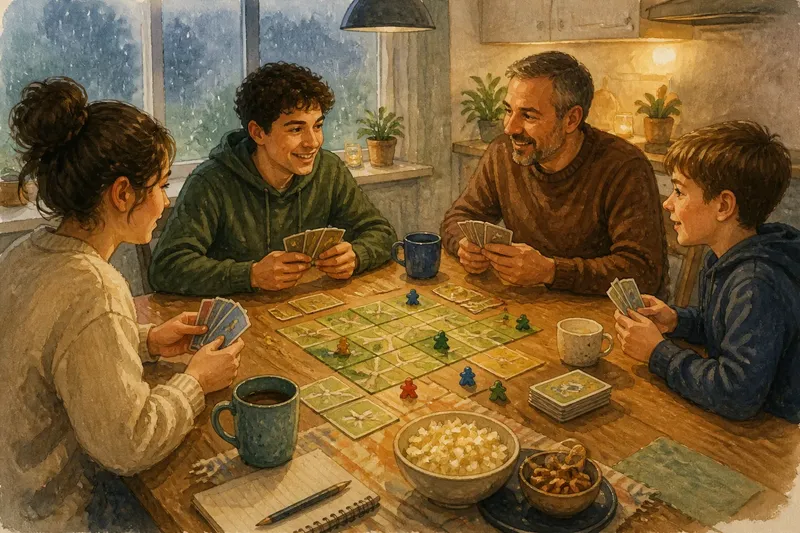
Rain taps the kitchen window while dinner plates are still drying, and the table has room for a deck of cards, a bowl of snacks, and a few elbows. A rainy-day game night works best when the game fits that ordinary scene, not an imagined game room. Choose for the surface you have, the people who can join, and the interruptions the evening may bring.
Use this list to make a practical choice before everyone sits down. The aim is not to pack the table with activity; it is to leave enough space for play to feel easy.
1. Measure the usable table
Look at the table after clearing only what you are willing to move. A game’s box may be compact while its play area sprawls across the surface, especially when cards, boards, player mats, or discarded pieces accumulate.
Consider the space each person needs for hands, a drink, and a place to set a card or token. A small card game or a compact tile game may suit a narrow dining table better than a board that expects players to reach across a central layout. Check the footprint of the game while it is set up, not just the dimensions of its box.
Keep one edge clear if people need to pass through the room or if the table also serves as a landing place for food. That strip of open space can prevent the game from becoming a barrier to the evening.
Move only what you can comfortably put away before play begins.
2. Count likely players
Count the people who are likely to sit down, rather than everyone who might visit. Then check the game’s player range and consider how it behaves at the smallest and largest group you expect. Some games feel lively with a few players but slow down as turns circulate through a crowd; others need several participants before their choices become interesting.
Think about late arrivals, too. A game that allows someone to join between rounds is often easier to host than one that assigns hidden roles or depends on everyone being present from the start. If the group includes children, visitors unfamiliar with the rules, or people who prefer to watch before joining, favor a game with a simple way to enter and leave.
Say you expect four people at dinner, but a neighbor may stop by afterward. A game that accommodates an extra player without changing the whole setup gives the group a natural choice: the neighbor can join the next round or sit out without making the current one awkward.
Choose for the group you expect, with a little flexibility for the group you get.
3. Look for pause points
Indoor gatherings rarely proceed without interruptions. Someone may answer the door, check on a child, bring out tea, or step away to take a call. A game that can pause cleanly is easier to keep beside those small obligations than one whose tension depends on uninterrupted attention.
Check whether a round has a clear end, whether a player can leave without derailing everyone else, and whether the current state is easy to remember. Games with separate rounds, visible turns, or a simple shared board are often easier to resume than games built around concealed information that must be protected throughout.
Imagine a host who needs to check the oven while a round is underway. If play can stop at the end of the current turn and the active player is easy to identify, the group can wait without reconstructing a complicated position. Agreeing on a pause point before starting is a small courtesy, not a special rule.
Pick a game whose natural stopping places match the evening’s likely interruptions.
4. Check the mess potential
For a small indoor space, consider not only the amount of equipment but also what happens if a piece falls, spills, or gets mixed with the wrong set. Cards and sturdy tokens are generally easier to gather than tiny loose components scattered near the edge of a table. A game that uses a dry-erase board may be convenient, but only if its markers have caps and the surface is suitable for them.
Food and play can share a room without sharing the same patch of table. Put snacks on a tray at one end, keep drinks on a stable side surface where possible, and avoid games that require pieces to be spread through a serving area. If the table is already crowded, choose a game with fewer components rather than relying on everyone to balance plates around them.
Check the game’s care instructions and any relevant local rules when those determine what materials are suitable. Otherwise, use a washable table covering if you already have one and keep paper components away from wet cups.
Before play, set a small dish or shallow bowl aside for loose pieces.
5. Match the game to the room
The room shapes how a game feels. In a close circle, conversation-heavy games can work well because players can hear one another without calling across the table. If people are spread around a long table or the room is noisy, favor games with clear visual cues, readable cards, and little need to catch every spoken detail.
Consider lighting and reach as part of the setup. Small print can frustrate players under a dim ceiling light, while a central board may be hard to see from the far end. Choose pieces and layouts that remain legible from each seat, or arrange people closer together before the game begins.
Also notice what the room must still do. A kitchen table may need to be cleared for a late meal, while a living-room side table may not have enough room for everyone’s cards. A game that packs away neatly can make the transition less abrupt.
Let the room’s ordinary uses set the boundaries for play.
6. Plan a simple setup
Once a game seems suitable, picture the first few minutes: where the box goes, where the pieces are placed, and who explains the rules. A compact game can still feel cumbersome if its setup involves sorting many components or creating separate personal spaces for each player.
Choose a game whose parts can be laid out without moving everything else off the table. If the instructions are substantial, read them before guests arrive and keep the rulebook nearby for questions. That preparation helps the group begin without turning the opening into a search through the box.
It can help to decide where used pieces go as the game progresses. A discard pile or a bowl for spent tokens keeps the play area orderly, and a designated place for the box lid prevents it from taking up a prime spot.
Set out only the components the chosen game actually needs.
7. Keep an easy alternative
A carefully chosen game may still prove too long, too quiet, or too demanding for the group’s mood. Have a second option that uses the same table and needs little explanation, such as a familiar card game or a word game played with paper. The backup should be genuinely easier to start, not another elaborate plan competing for attention.
Offer the alternative without framing it as a failure. A group may enjoy the first game for one round and then prefer conversation, or someone may arrive late and want to join something immediately. Letting the evening change course is part of planning for a real gathering.
For a rainy-day game night, the best choice is the one that leaves room for people to come and go, pause, and enjoy the table they actually have. Before guests arrive, make the final check: can everyone reach the pieces, can the game stop at a sensible point, and can the surface be restored without fuss? If the answer is yes, leave a clear place for the snacks and let the weather keep tapping at the window.