Before the Scoreboard: Keeping Track of Play
Keeping track of play with a spoken tally, counters, or pencil marks helps players settle the count and return their attention to the game.
A child calls “three” beside a chalked hopscotch grid, and another repeats it while waiting for a turn. Keeping track of play often starts with a count spoken aloud, giving everyone the same place to pick up from.
Scorekeeping is less like administration than a small shared memory. Its form can be a voice, a mark, or a note, but the record is useful only if players understand what it represents.
Spoken tallies
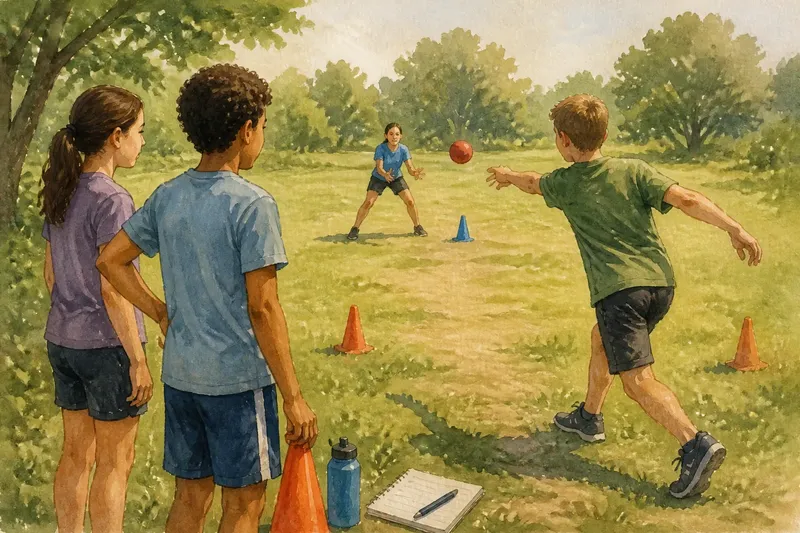
In a game with a simple sequence, a spoken count is often enough. Players can count successful throws, completed laps around a yard, or turns taken, repeating the latest total as they go. Anyone who hears a missed count can raise it while the action is still fresh.
Agree on what earns a point before the game begins. If a ball touches a boundary, for instance, players need a shared rule for whether the play counts; otherwise, a confident call can sound like a ruling made for everyone.
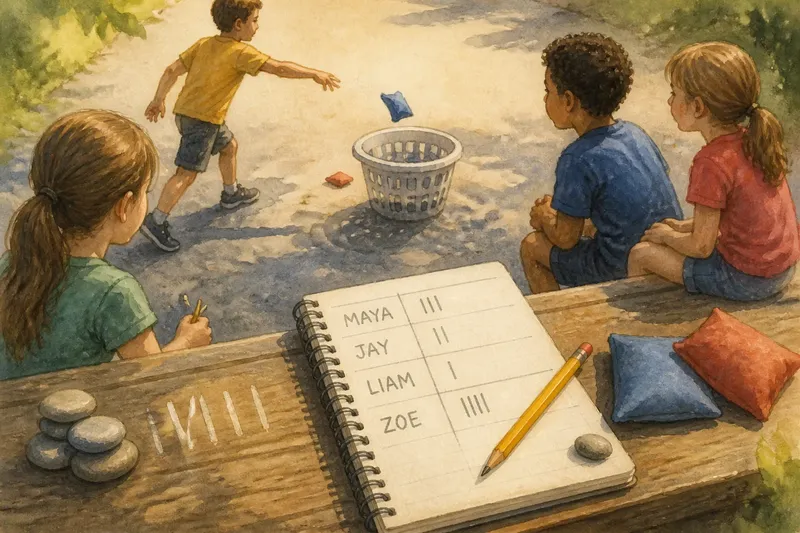
Say a few friends are tossing a beanbag into a laundry basket, with a point for each beanbag that lands inside. After each round, one player says the total and the others repeat it. If someone notices a missed point, the group can correct the spoken count before the next throw.
Say the total clearly, and leave room for a correction.
Visible marks
When speech gets lost in a noisy yard or a longer game, a mark gives the count a visible home. A stick in dirt, a chalk line on pavement, or a pebble moved from one side of a bench to the other can represent a point or turn.
Choose a method that fits the setting. Scrap paper can hold tally marks; counters are easy to move when players’ hands are free; stones are convenient outdoors but can be kicked or shifted. Keep the record where everyone can see it without crowding the play area.
Before play, give each mark a clear meaning: one line for a point, a completed round, or a team’s turn. Keep it distinct from boundary lines and other game markings.
Use marks the group can read at a glance.
Paper records
A notebook page helps when a game lasts through a break or needs to track names and rounds. Write players’ names in a consistent order, add one result at a time, and leave room to correct an entry clearly. A pencil makes revisions easy; a reusable whiteboard can be easier to see from across a yard.
A short note can preserve where play paused, such as which team was due to take a turn. But if writing interrupts the game, switch back to a spoken tally or a few marks.
Rules for the record
Groups may count upward, count down, record every point, or note completed rounds. Any of these approaches can work if players agree on what the marks mean and how to update them.
For a new or adapted game, settle three questions before play: what counts, who updates the record, and what happens when a play is disputed. Keep the answers short enough to remember during the game.
- Check whether everyone can see the record; if so, keep it in place, but if not, move it to a shared spot or use a spoken tally.
- Check whether players agree on what earns a point; if so, start counting, but if not, state the rule before the next turn.
- Check whether a mark represents a point, turn, or round; if the meaning is clear, continue, but if not, label it or choose a different mark.
- Check whether the record must survive a pause; if so, use paper or a whiteboard, but if not, use counters or a spoken count.
- Check whether the chosen tool is likely to be disturbed by wind, feet, or other activity; if it is stable, keep using it, but if not, move the record or choose a more secure method.
- Check whether writing or updating marks is interrupting play; if it is not, keep the record, but if it is, simplify to a spoken count or stop scoring.
Imagine four players starting a beanbag game with a notebook and pencil. They agree that a beanbag landing in the basket earns one point, write their names in turn order, and add a tally after each round. When a stray beanbag knocks the notebook off the bench, they move it to a dry, visible ledge and continue; the record stays legible, though they trade the convenience of a nearby writing surface for a steadier place.
What should the record do?
Does every game need a score?
No. A count may help organize turns or settle a close contest, but players can leave it out when they would rather repeat a skill or change the rules. If scoring interrupts the activity, continue without it.
Who updates the score?
Anyone who can see the relevant action can announce or record the result, provided the group agrees on how it is counted. For a small group, players can confirm each update aloud before the next turn.
What if players disagree about a point?
Pause and apply the rule agreed on before play. If it does not cover the situation, choose a fair way to continue and say how the same situation will count next time.
When is paper better than counters?
Paper suits a record that needs to last through a break or include names and round details. Counters suit a visible total that changes during play, as long as they can stay in a stable, shared spot.
Keep score in view
A spoken tally keeps attention on the current turn; chalk or counters make a changing total visible; paper can hold names and round details through a pause. The right form depends on what the group needs to remember.
For keeping track of play, choose the simplest record that answers the group’s actual question. Before the next round, put the tool where players can see it and return their attention to the game.